
San Rafael is the biggest city in Marin, and its yards are as varied as its neighborhoods. Down near the bay and along the Canal, lots sit only a few feet above the water, and the soil stays soaked for much of the winter. Climb into Sun Valley, Glenwood or Peacock Gap and the same storm turns into runoff racing down steep driveways and across hillside gardens. In between, older neighborhoods near downtown have mature trees, narrow side yards and patios that were laid decades ago on whatever base was handy at the time. A layout that thrives on a Glenwood hillside would drown on a Canal-area lot, and the reverse is just as true.
We plan every San Rafael yard around the ground it sits on. On flat, wet lots that usually starts with drainage that keeps water away from the house. On slopes, it's walls, steps and terraces that make the yard usable. Almost everywhere, it means replacing tired lawn and thirsty shrubs with planting suited to Marin's dry summers. Ring us or send the estimate form, and we'll pick a day to walk your yard.
Low Ground Near the Bay and the Canal
The east side of San Rafael, from the Canal neighborhood out toward Loch Lomond and Bayside Acres, sits on low, flat land close to the bay. Much of it is heavy clay with water not far below the surface, and in a wet winter the ground simply has nowhere to put more rain. Puddles linger for days, lawns turn to mud, and patios laid without enough slope stay wet and grow moss. Here the fix starts below the surface. Regrading so every bit of the yard falls away from the house, a catch basin at the low spot, solid pipe from the downspouts, and an outlet that actually works at the elevation of the street. Raised planting beds keep roots out of standing water, and gravel paths drain far better than lawn between them. Driveway runoff and roof water have to be sent somewhere useful too, since the street drains on these flat blocks can back up during a high tide and a heavy rain at the same time. Hardscape needs a deeper, better-drained base than it would on a hillside, which is why we pay close attention to how patios are built on wet ground here.
Hillside Yards From Sun Valley to Peacock Gap
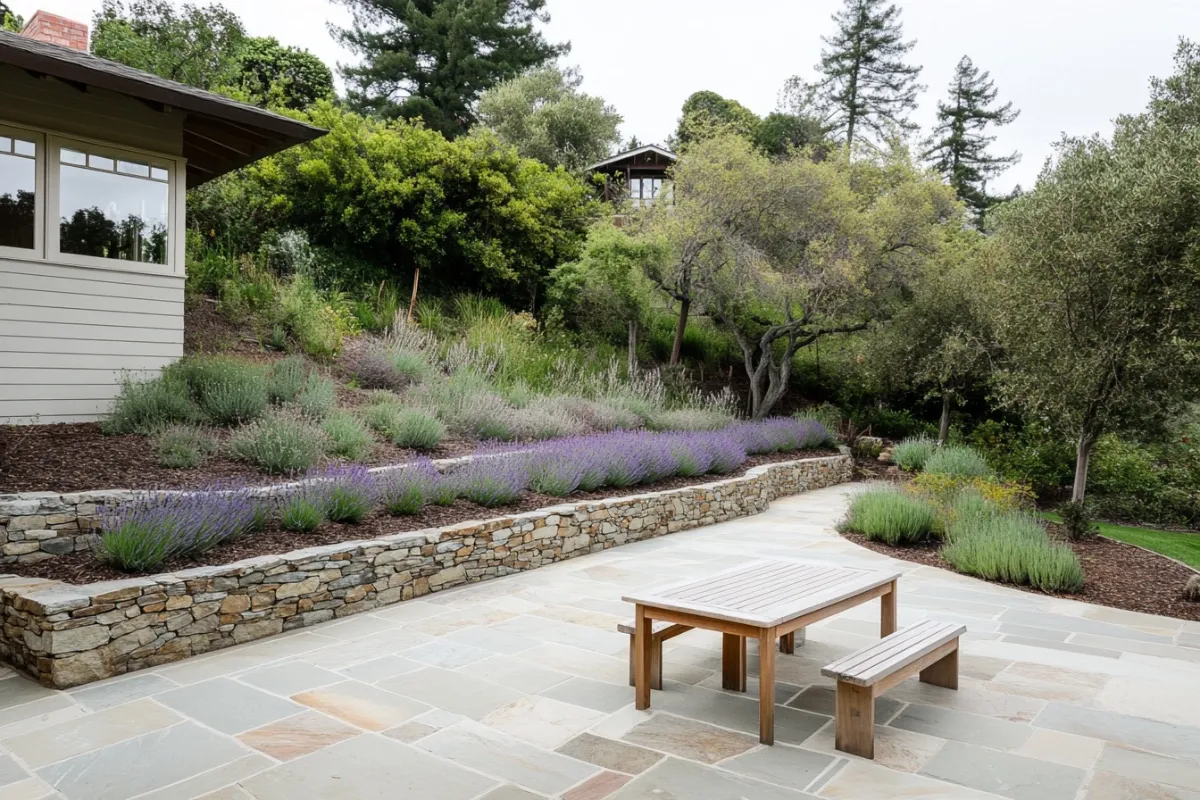
On the other side of town, the challenge flips. Neighborhoods like Sun Valley, Glenwood and Peacock Gap climb steep slopes, and many backyards are barely usable as built: a narrow patio by the house, then a bank of ivy or juniper running up to the fence. Turning that slope into space you can enjoy usually means terracing it with a pair of walls, adding steps and a landing, and planting the banks with deep-rooted shrubs that hold soil better than ivy ever did. Runoff matters as much as the walls. Water from the street and from uphill lots can pour across these yards in a storm, so we catch it at the top and carry it around the house instead of letting it soak behind new walls. Deer are a constant up here too, and plant choices have to account for them. Fire matters as well: these neighborhoods back onto open hillsides, so the planting closest to the house stays low, sparse and well irrigated, with gravel or stone right against the walls. The same hillside approach carries over to the steep lots just west of town in San Anselmo.
San Rafael Landscaping Questions
Mostly when it's tall or carrying weight. California's building code generally requires a permit for walls over four feet, and that height counts the buried part down to the footing. A shorter wall can still need one if a driveway, a slope or a structure sits above it. San Rafael's building division handles these permits, and steep hillside lots can get extra review. We sort out whether your wall needs one when we see it, and we coordinate the engineering when it does.
Deep-rooted shrubs and ground covers that hold soil and don't need much summer water. Manzanita, ceanothus, coffeeberry and native grasses all work well on San Rafael's sunny slopes, and most are left alone by deer. Ivy and ice plant look like they hold a bank, but their roots are shallow and heavy wet growth can slide in a storm. On very steep ground, we pair new planting with erosion fabric and a drip line so the plants establish before the next winter.